No 9H

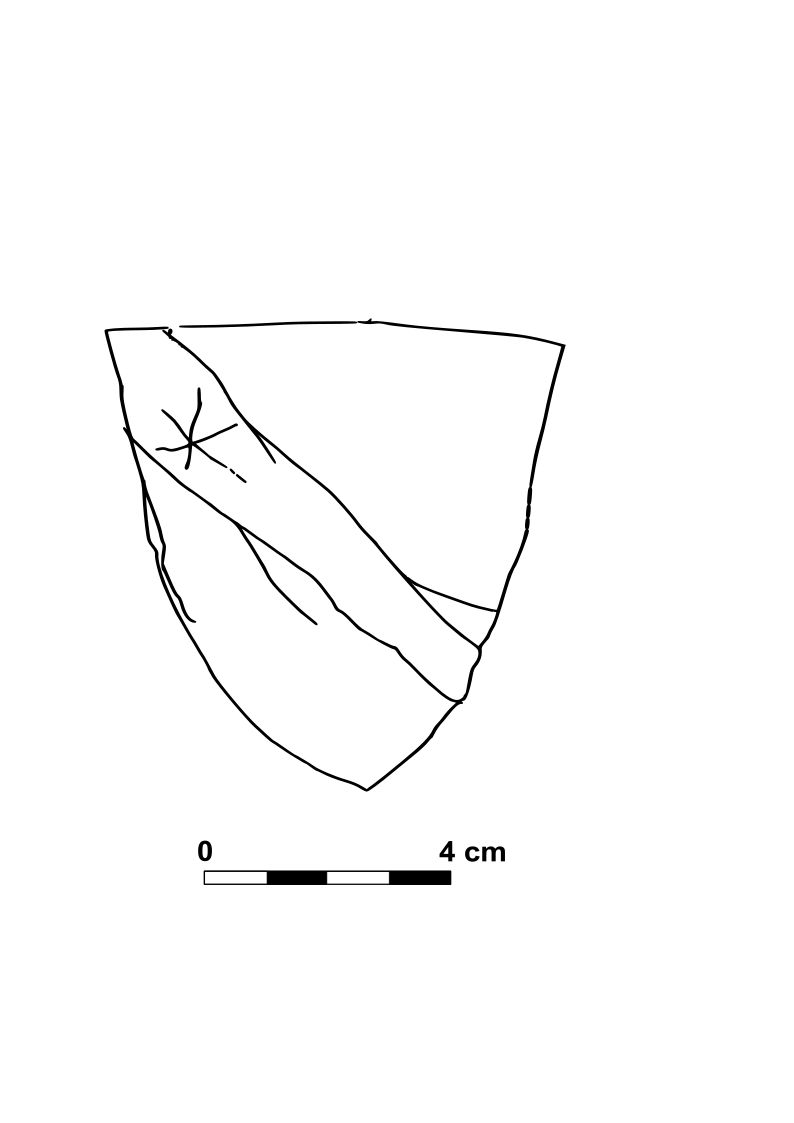
Location: Northern gallery, north-eastern pier, northern inner wall.
Material: Marble surface, 6th century.
Dimensions: Width 7.5 cm, height 7.8 cm; about 160 cm above floor level.
Condition: Sharp engraving, no interlaced with others.
Technique: Incised.
Blazon: Wavy bend with a six-pointed comet. Gothic shield.
Аttribution (Th. Thomov): Chalon-Arlay family (France), 1258–1560.
Attribution (M. Gorra): Milorati family.
Publications: Tomov, T. Gerbove-grafiti ot hrama „Sv. Sofija“ v Konstantinopol, BǍLGARSKO CARSTVO. Sbornik v čest na 60-godišninata na doc. d-r Georgi N. Nikolov, Sоfia: Universitetsko izd. "Sv. Kl. Ohridski" 2018, 679-687; Gorra, Maurizio. Observations and reflections on some coats of arms graffiti in Santa Sofia in Constantinople, Academia.edu
Commentary: The engraving is quite confusing in outlining the edges of the division and presents a significantly simplified figure outlined in low relief, making unambiguous interpretation difficult. The identification of the figure as a comet is based on the fact that the lower ray, although uncertainly outlined, appears somewhat longer than the others (see Appendix 9).
The attribution to the Chalon family is possible, especially given their connections with Turkey in 1366–1367, but the artifact offers no strong proof for further attribution. The coat of arms appears to correspond to that of the Milorati family (Sulmona), whose most famous member was Cosma, who became Pope Innocent VII (1404–1406); two of his nephews, Lodovico and Gentile, were notable military figures in the first half of the 15th century. Although none of them are known to have visited the Near East, their renown certainly spread beyond Italy, particularly as Pope Innocent VII, in his role as pontifex, was considered fully “Roman” during the difficult decades of the Great Schism with the West.
This hypothesis is supported by the specifics of the Milorati arms (see Appendices 10 [Popes’ Gallery of Palazzo Altieri in Oriolo Romano, Viterbo] and 11 [author’s drawing]), a bend with a wavy comet along the division, reflected in the graphic metonymy of the engraved coat of arms, where the comet appears without a tail and the entire bend undulates. It is hard to believe a Milorati would make such an error in depicting their arms, but it is easy to think of a misinterpretation of the figures, as shown in one of the few known examples of Innocent VII’s arms (see Appendix 12 [Milan, Basilica of San Ambrogio; artifact in the public domain from the Internet, image taken by author]), where the movement of the comet is represented by dashes in the bend, as is common in modern comic representations.
Date: Uncertain, like the attribution.