No 18D

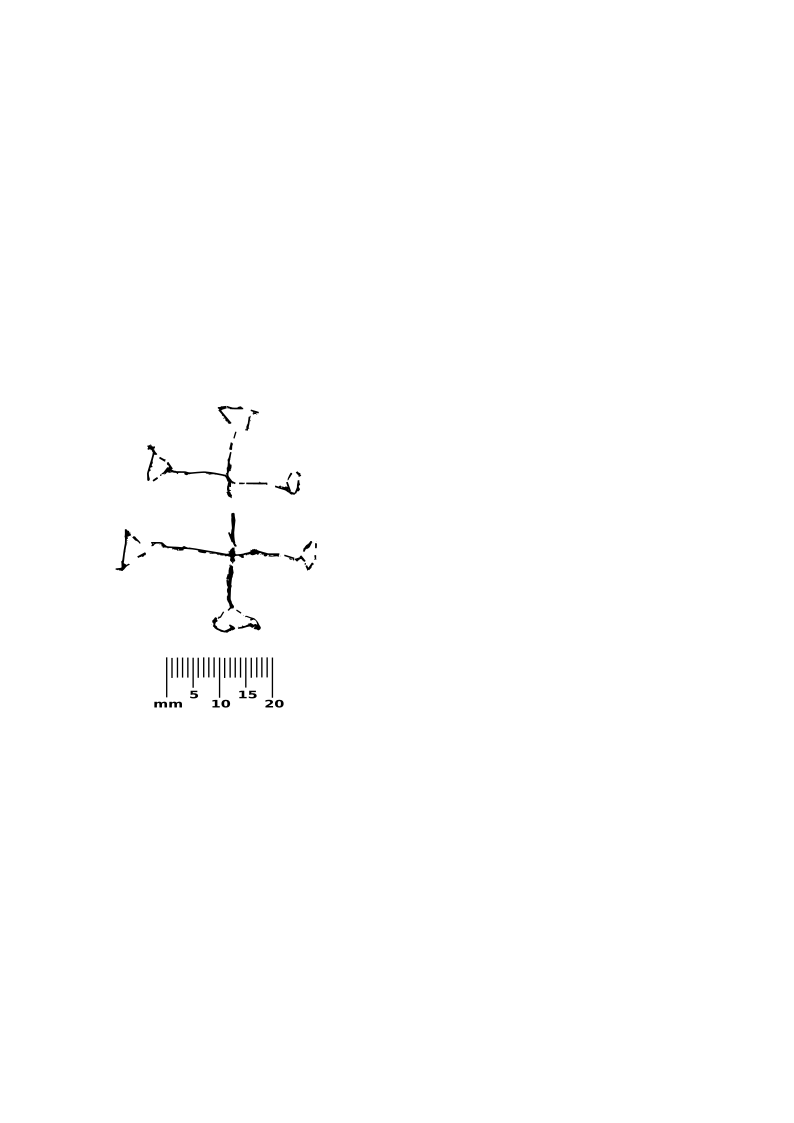
Location: On the parapet of the last box, from right to left, in the central part of the north gallery.
Material: Marble surface, 6th century.
Dimensions: 4.6 cm (height) x 3.8 cm (width).
Condition: Deeply incised, not intersected by other marks.
Technique: Incised.
Description: Contour drawing of a patriarchal cross whose arms at the end have an enlargement in the form of triangles.
Аttribution: A universal sign of Christian presence and a direct appeal for divine aid, along with a powerful apotropaic function.
Publications: none.
Commentary: The Latin cross with two transverse arms is known as the "patriarchal" or "archiepiscopal" cross, symbolizing the Holy Cross. The upper arm represents the titulus—the inscribed plaque of Christ's condemnation. Historically, it served as an insignia for high-ranking prelates like patriarchs and archbishops. It first appeared on Byzantine coins in the 8th century, became widespread in Christian art after the 10th century, and from the 11th century, it was used as an attribute of the Risen Christ, signifying His Passion.
Date: Middle - Late Byzantine period?