No 7D

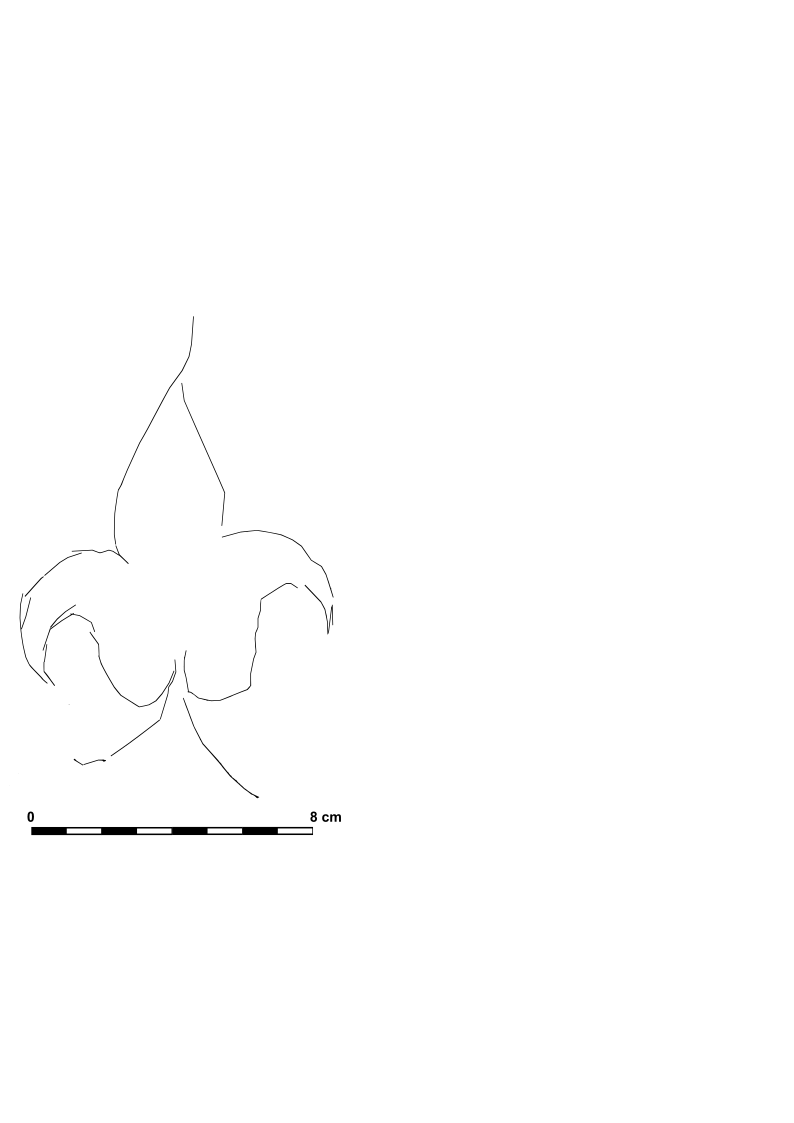
Location: On the fourth marble slab of the paneling, on the wall to the left of the so-called “Empress' Box”.
Material: Marble surface, 6th century.
Dimensions: 14 cm (height) x 9 cm (width), at eye level.
Condition: Shallow, but clearly carved.
Technique: Incised.
Description: The graffito depicts a stylized fleur-de-lis, consisting of a central vertical stem that rises to a pointed tip, flanked by two symmetrical, outwardly curving side leaves. Although schematic, the motif is unmistakable and corresponds closely to the floral ornaments in the church’s architectural decoration.
Аttribution: Devotional or ornamental mark.
Publications: none.
Commentary: The motif has clear parallels with the floral and palmette designs on the Imperial Door and other decorated portals of Hagia Sophia[1]. These ornamental forms were part of the established Byzantine decorative vocabulary, often charged with symbolic connotations of purity, victory, and divine grace.
While the fleur-de-lis became a heraldic emblem in the West, most famously associated with the French monarchy, in Byzantium it remained a generalized floral ornament, flexible in its symbolic use. Its presence as graffiti in Hagia Sophia should be interpreted not as a direct Western influence but rather as a local devotional mark or an imitation of the church's own monumental decorative program.
Date: 13th–16th century AD.
[1] Swift, E. The Bronze Doors of the Gate of the Horologium at Hagia Sophia. College Art Association, University of Chicago 1937, 147; Mainstone, R. Hagia Sophia: Architecture, Structure and Liturgy of Justinian’s Great Church. London: Times and Hudson 1988, 29.