No 3
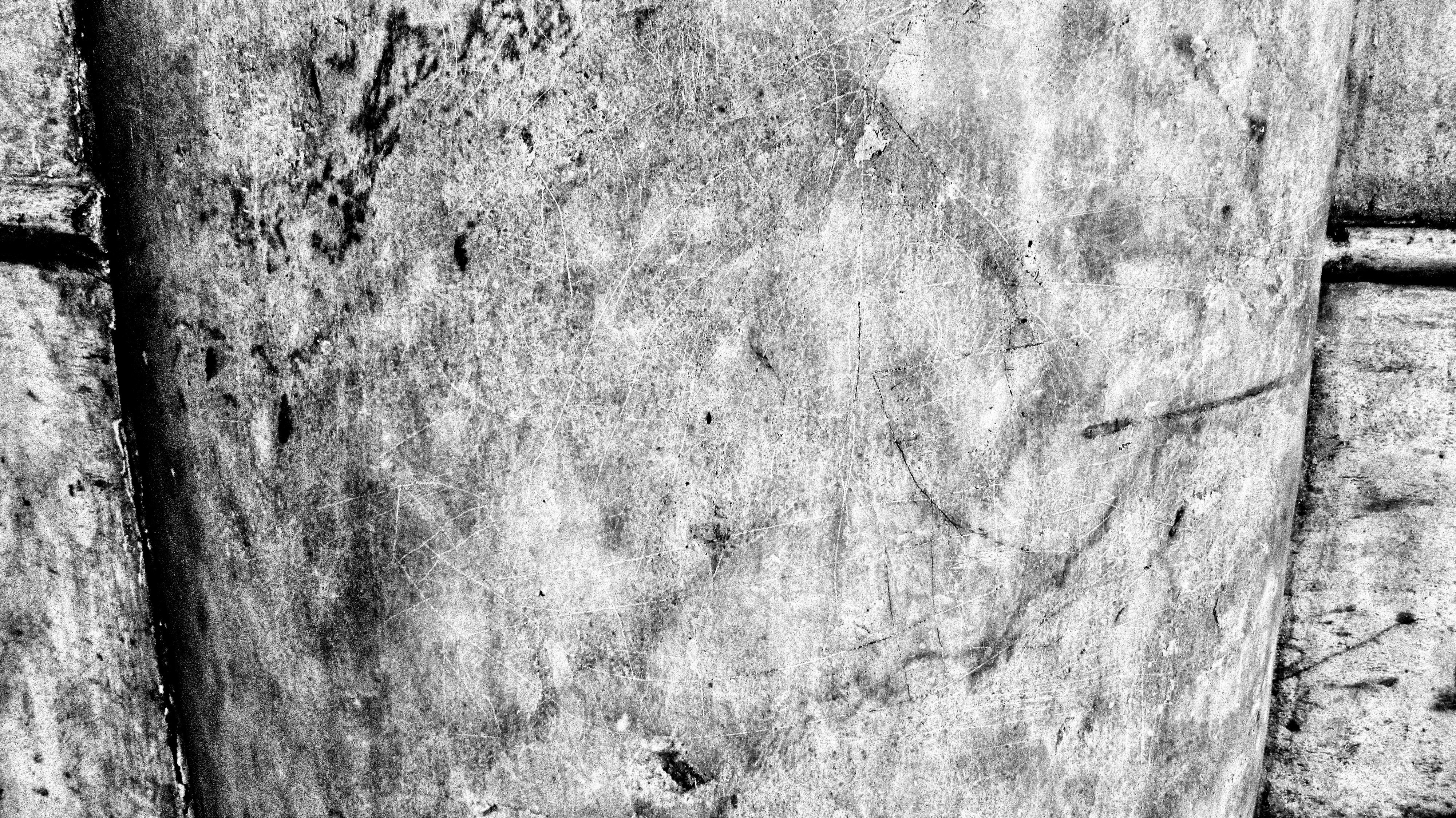
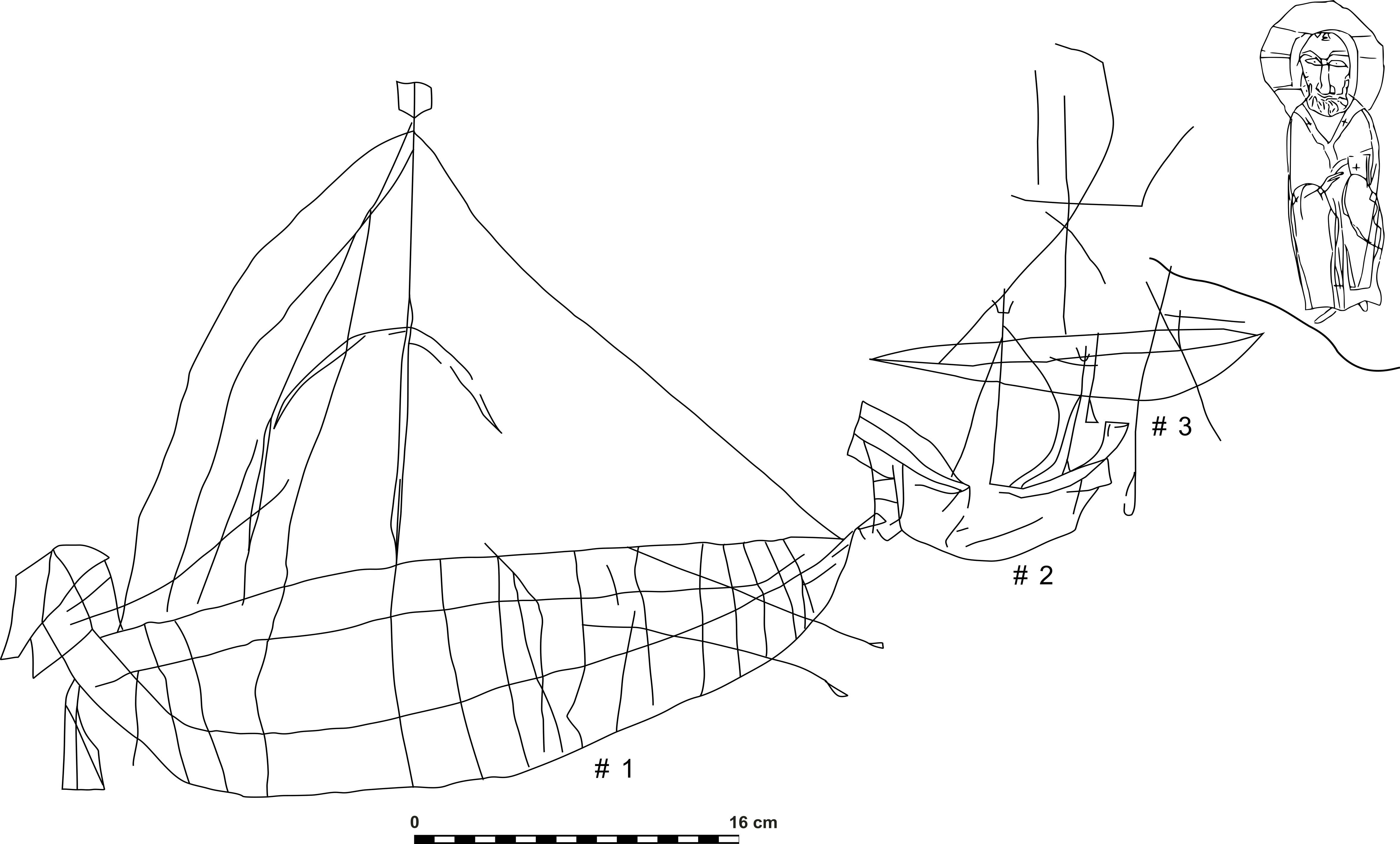
Location: On the last or the easternmost marble column of the balustrade in the western part of the southern gallery, right next to the left edge of the so-called "Gate of Heaven and Hell".
Material: Marble surface, 6th century.
Dimensions: No. 1 is 8 cm high, 33 cm long, at a height of 98 cm from the floor level; No. 2 is 8.9 cm high, 10.7 cm long, at a height of 110 cm from the floor level; and No. 3 is 1.5 cm high, 12 cm long, at a height of 115 cm from the floor level. The human figure, which is 3 cm wide and 11.5 cm high, is positioned about 115 cm above the floor level.
Condition: Shallow carving, uninterrupted by others.
Technique: Incised.
Description: Three ships, arranged diagonally and ascending towards a human figure facing them with a halo, thus forming an ex-voto scene with a maritime theme.
The sailing direction of the Ship # 1 is to the right. It has a curved keel, a slightly inclined sternpost and a curved stem post. Details of the superstructure are clearly represented. Over the sternpost a little three-dimensional cabin or stern castle is depicted, crowned by a roof. The main mast (one vertical line) is set slightly to the rear of mid-ships and topped with a crow’s nest. Its nearly vertical orientation, however, is inconsistent with a lateener. Five lines depicted fore and aft of the mast, running up to the top of the mast and again along the sides of the mast, are apparently meant to indicate the shrouds, which are located both to port and starboard. The main mast carries a curved yard with completely furled sails. The traditional pair of big broad quarter-rudders is depicted. The second rudder is probably only partially depicted by one diagonal line drawn in front of the complete one. Both rudder blades, attached to a round loom, are asymmetrical, indicating that they are unbalanced rudders. There are only two oars with blade and they are out of proportion. The triangular projection at the stem may portray a sort of bowsprit, which is called ‘sperone’ or ‘spiron’. The entire hull of the ship is presented in a three-quarter view from above and is turned towards the viewer. The depicted angle of view reveals details of the inner hull construction. Beams or frames are arranged perpendicularly to the keel. The frames are evenly spaced, although 14 frames are insufficient for a ship of this size. Two of the lower strakes, running parallel to the keel, have been attached to the framing.
The Ship # 2 depicted in profile is relatively small and the sailing direction is to the right. The hull is round with a mounted stern deck, while the stern rises rather steeply at the bow. The sternpost is almost straight and at a slight angle to the keel. The stempost-mounted rudder is clearly depicted. It is shown attached with iron pintles and gudgeons. Above the stern is a large and high aftercastle, perhaps with two or three decks. It continues forward for approximately one half of the vessel’s length. The forward end of the aftercastle has an indentation in it before it descends to the deck. The ship is equipped with a smaller, but high forecastle with a hint of parapet. It also had an additional deck level at the bow. The castles at bow and stem are molded into the vessel’s contour. Between them, the low part of the hull or the so-called ‘waist’ is confined. Two clearly visible slanting lines probably represent two masts: the fore and the main. They are at a slight angle to the hull. Both are topped with a crow’s nest. Very little of the rigging is detailed. No yard is shown on the main mast but the main sail is depicted by a curved line fore of the mast. One shroud line is delineated aft of the mainmast. The yard of the foremast appears to be horizontal and two shrouds are clearly visible. The sail itself is not shown.
The sailing direction of the ship # 3 is to the left. The hull is narrow and sleek, and there is no overstructure depicted. The galley has no sperone but does have a protective rail over the oars. Only one oar is depicted on the portside. The main mast stands slightly forward of amidships. Its vertical orientation is inconsistent with a lateener. One diagonal line on the mainmast constitutes the yard. No sail is indicated. At least one shroud is shown running fore of the mast. A horizontal bar served to support a lent is shown at the stern. The criss-cross lines on the stem may represent a pair of big broad quarter-rudders. The quarter-rudder on the portside is out of proportion and too long. Only one rudder blade is depicted in a reversed position, which would seem to indicate that the vessel is moored in a port.
The human figure, which is set at the curved coastline, has an expressive feature of' an elderly man with figurative eyes, a trim, round beard and balding head. He is depicted in episcopal vestments, wearing the omophorion and holding a Gospel Book or St. Nicholas of Myra.
Type: No. 1 - C/Ib or IIa?; No. 2 – C/IIb and No. 3 – C/Ia (ex-voto scene with protective saint or St. Nicholas).
Attribution: No 1 - hybrid ship - commercial galley or short cargo ship?; No 2 - Carrack; No 3 - Light galley or galea sottili.
Publications: Тh. Thomov, Maritime ex-voto graffito from the church of Hagia Sophia, Constantinople, Byzantinoslavica LXXIII/1-2 (2015) 55-72; Tomov, Potajnostite na "Sv. Sofia", 65-73.
Commentary: Tomov, Potajnostite na "Sv. Sofia", 66-73.
Date: Between 1350 and 1450 AD.