No 7D

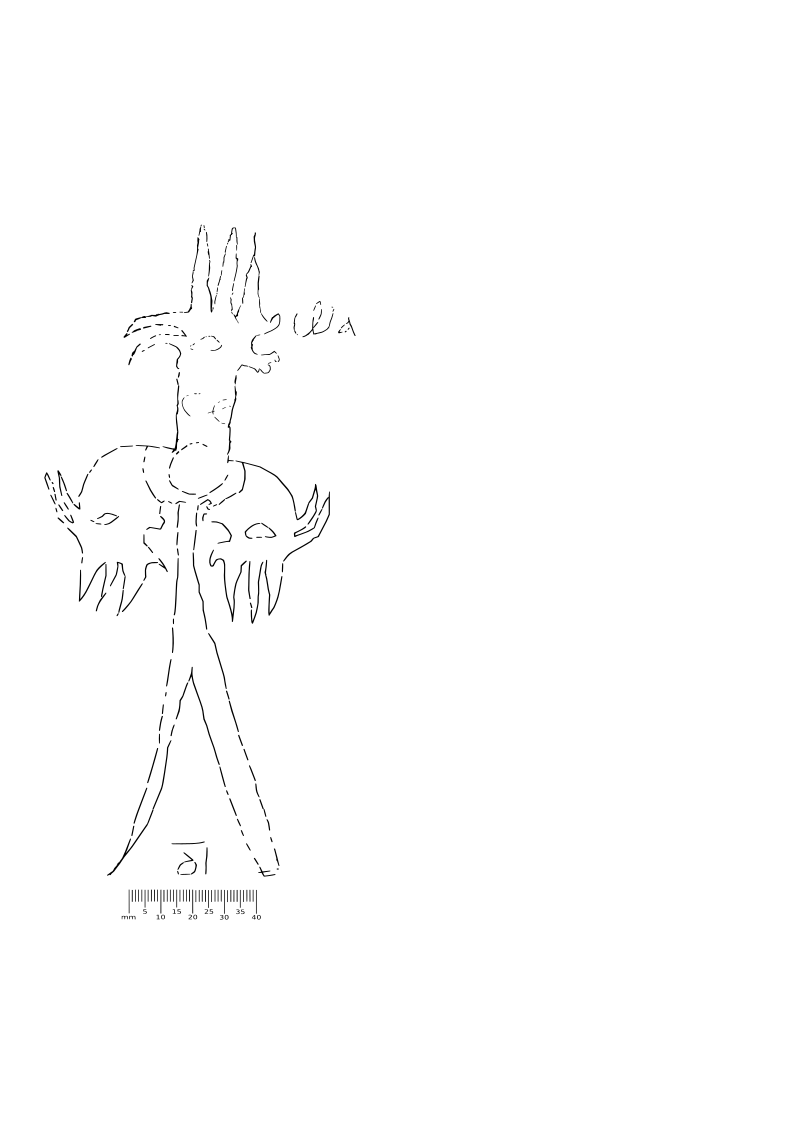
Location: On the short wall on the left side of the false marble gate in the western bay of the southern gallery.
Material: Marble surface, 6th century.
Dimensions: Height 22.5 cm, width 9 cm at approximately 140 cm from the floor.
Condition: Lightly incised, not intersected by others.
Technique: Incised.
Description: The figure consists of three parts. The upper part is a vertical rectangle, culminating in a triple vertical crest. On the left, there is a curved, double-pointed crest, and on the right—a horizontally inverted letter U, its curved part facing inwards. Its open end forms an upper and a lower lip. A small ellipse is placed between the double-pointed crest and the mouth.
A circle is placed in the centre. From it, small figures extend to the left and right, featuring a double-pointed crest on their outer side and a triple crest in their lower part. On their inner side, the figures have a U-shaped form—the left one is slanted, while the right one is horizontal. Here too, a small ellipse is placed between the double-pointed crest and the U-shaped part of these figures.
The lower part of the main figure is an inverted Latin letter V, with its sharp tip pointing towards the centre. Its left part is pointed at the bottom, while the right part is rectangular; at the bottom end, a line marks a small, partially unclosed rectangle.
Opposite the upper right part of the figure, the inscription "ΦΑ" is legible (length: 2 cm; letter height: 1.2 cm for Φ and 0.6 cm for A). Slightly below it, the letters "CΕ" can be discerned, which together form the word "ΦΑCΕ/φᾶσε" (length: 1.8 cm; letter height: 0.8 cm). The sigma and epsilon are lunate. Below and in the centre of the inverted V, "δι" is inscribed, with a minuscule delta (length: 1.1 cm; height: 0.8 cm for δ and 0.9 cm for ι). The inscriptions contain no dates, and consequently their dating is problematic; we can only date them approximately. Judging by their palaeographical features, they appear to have been created between the 10th and 13th centuries AD.
Attribution: A composite representation of a cherub-tetramorph and a sacred animal based on the Visions of the Prophets Isaiah and Ezekiel, as well as the Revelation of John.
Date: Unknown.