No 19D

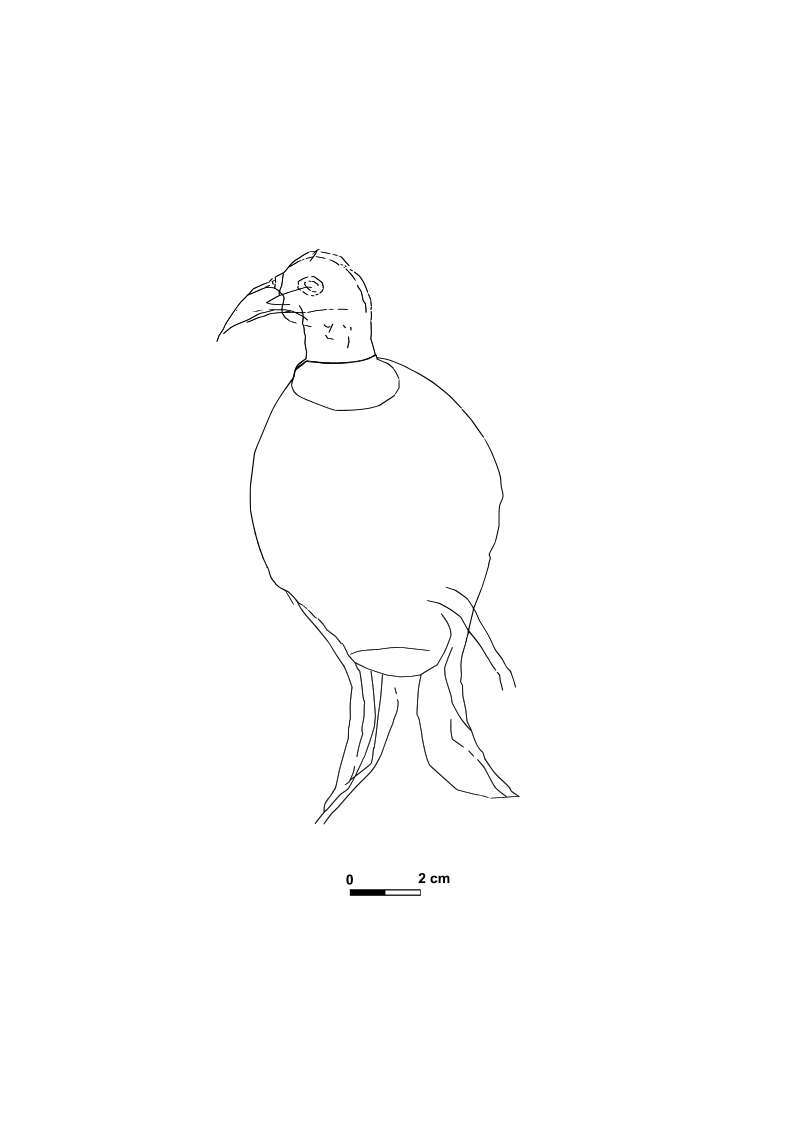
Location: On the south side of the first pillar (from right to left) on the east wall of the south gallery.
Material: Marble surface, 6th century.
Dimensions: Height 17.5 cm, width 8 cm, at 110 cm from floor level.
Condition: Lightly incised, not intersected by other marks.
Technique: Incised.
Description: The drawing depicts a single-headed eagle in a heraldic posture with wings close. The bird's head, turned to the left, is firmly set on a straight, short neck and is well-executed. The eye is small, formed by two concentric circles, and the beak is large, sharply pointed, closed, and disproportionately elongated. The head is bare, lacking any crest or ear coverts. The body is massive with a strongly protruding breast, giving it a teardrop-like shape. A sort of collar or scarf on the neck separates the head from the body. The short, forked tail is drawn with six feathers, and the ends of the outer feathers point downwards. The bird has one powerful leg, with barely noticeable spread claws.
Attribution: An unfinished ornithomorphic representation, likely symbolizing power or the triumph of good.
Publications: none.
Commentary: Despite the notion of Byzantium inheriting the single-headed eagle as an imperial emblem from Rome, its primary use appears to have been as a military insignia, which fell out of use relatively early. It never featured on Byzantine flags, which predominantly bore images of saints, and it disappeared from coinage following the reign of Emperor Heraclius (610–641). While imperial silk robes with single-headed eagles are known in Western Europe, they are relatively few.
The tradition of the single-headed eagle persisted longer in reliefs and miniatures. For instance, in depictions of the Palaiologan dynasty, the motif is reproduced on the foot cushions of the enthroned basileus. However, during the Komnenian period, the single-headed eagle was largely supplanted by the double-headed eagle, introduced via Eastern fabric fashion as an ornament for court garments. Nevertheless, evidence confirms that the tradition of the single-headed eagle remained alive in Byzantium as late as the 14th century. Unfortunately, due to its unfinished state, the eagle from the graffito lacks an exact parallel.
Date: 10th-13th century AD.