No 21D
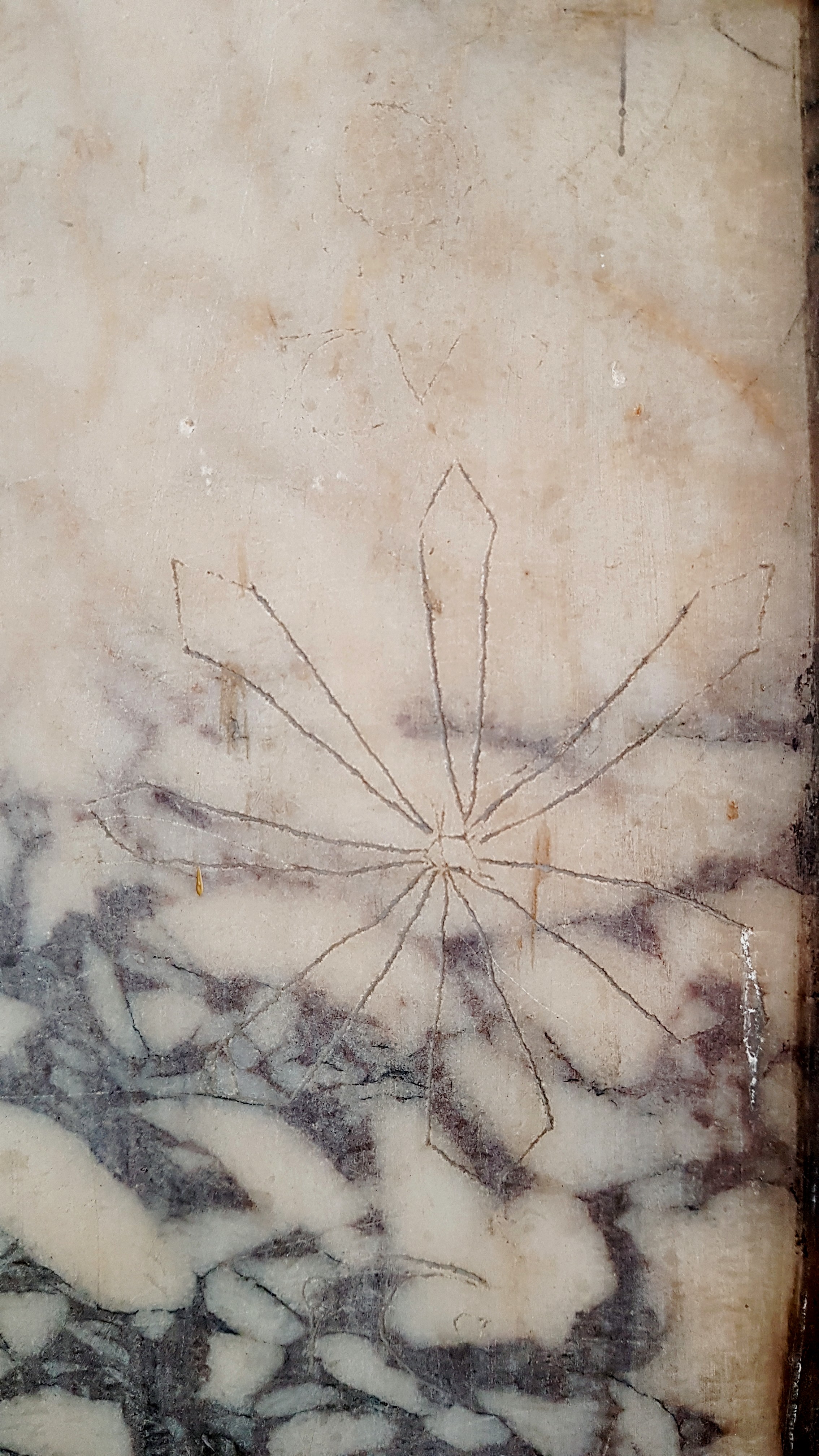
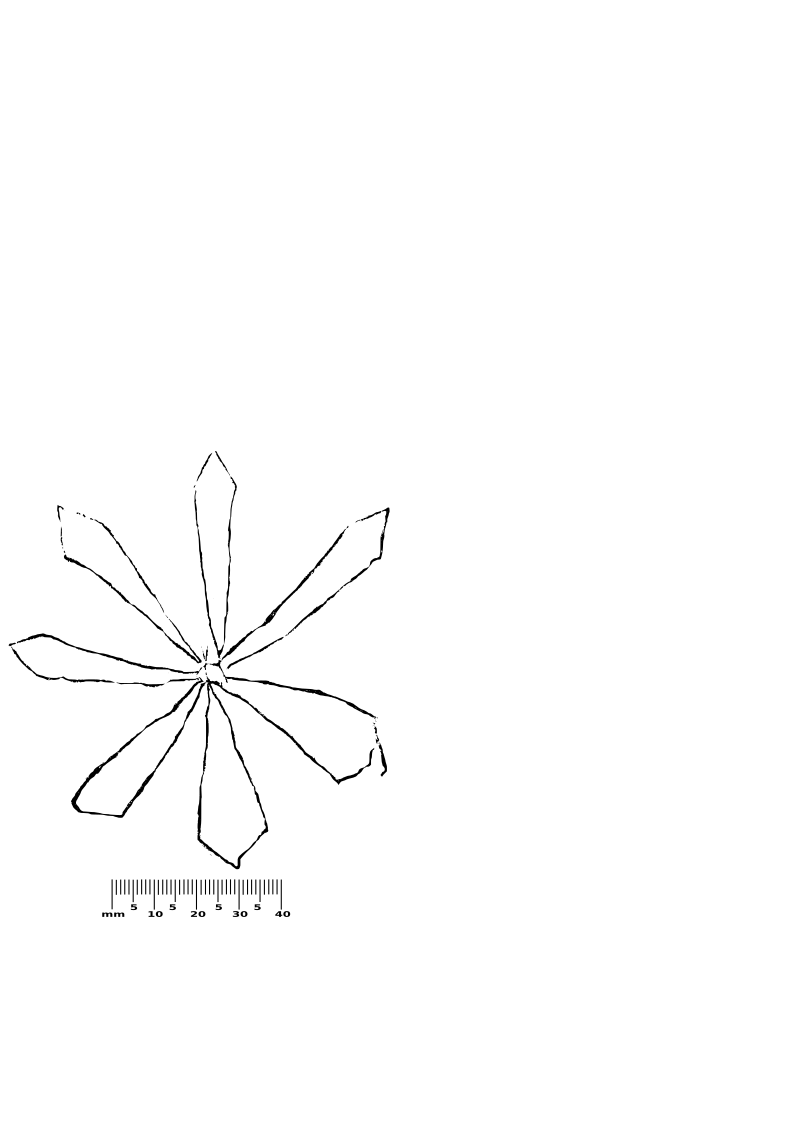
Location: On the southeast corner of the short east wall, in the central part of the southern gallery, near the tombstone of Dandolo.
Material: Marble surface, 6th century.
Dimensions: Diameter: approx. 9 cm, at eye level.
Condition: Lightly incised, not intersected by other marks.
Technique: Incised.
Description: The design represents a small circle with seven radial rays emanating from it, forming seven-ray motif, resembling a daisy-wheel.
Attribution: An unusual variant of the daisy-wheel or apotropaic wheel motif.
Publications: none.
Commentary: This incised seven-ray design, carved into marble, represents an unusual variant of the daisy-wheel or apotropaic wheel motif. While the canonical hexafoil (six-ray) form is geometrically derived from compass-drawn interlocking circles, the presence of seven rays constitutes a notable deviation from the standard geometric construction. Such irregular or modified versions are extremely rare in documented Byzantine contexts and may reflect intentional symbolic adaptation rather than error.
Apotropaic wheels were widely used in sacred and domestic spaces across the Byzantine world — on church walls, thresholds, and columns — where they were believed to repel evil and invoke divine protection. The deliberate symmetry and careful incision of this seven-ray pattern suggest a ritual or protective purpose, not casual ornamentation. Within the visual language of Byzantium, star-like and solar motifs expressed both cosmological harmony and divine order, continuing a lineage of protective symbolism with roots in late antique and pre-Christian traditions.
Although no securely attested seven-ray daisy-wheels are recorded in major archaeological or iconographic corpora, this specimen may represent a localized or improvisational variation of the apotropaic mark, possibly influenced by the sacral significance of the number seven in Christian cosmology — symbolizing creation, completeness, and divine protection.
Date: Unknown.