No 22D

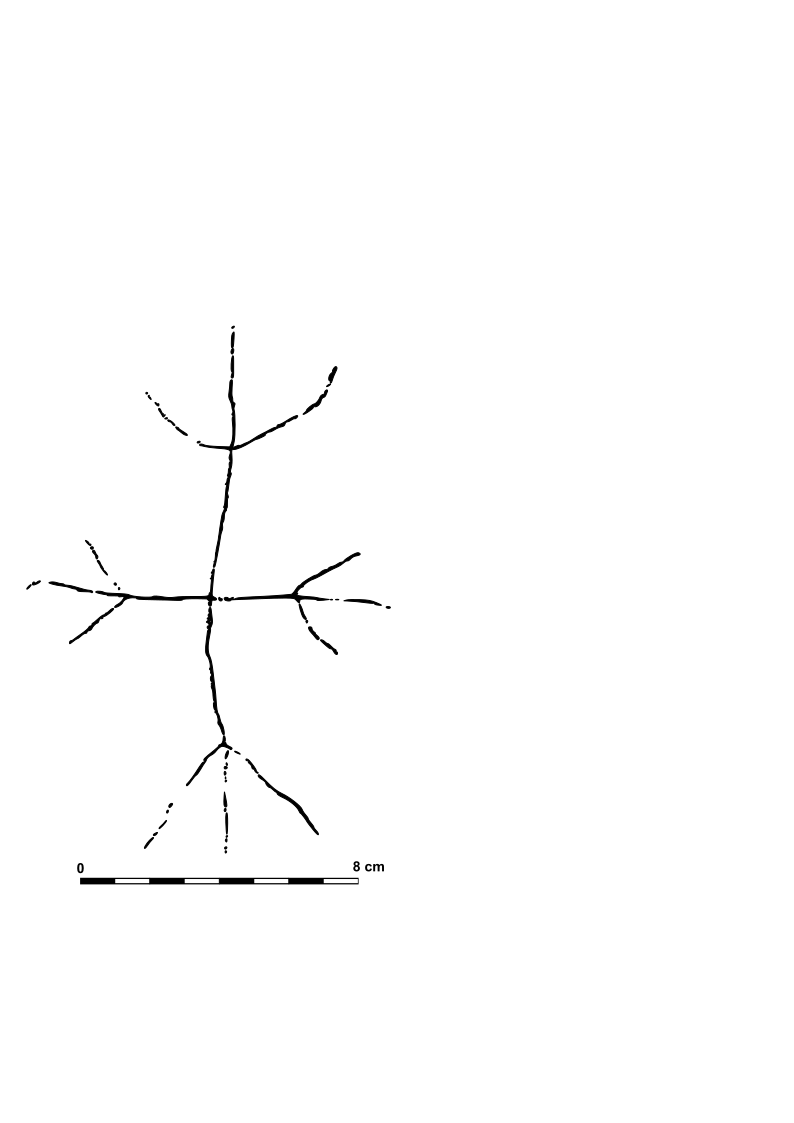
Location: On the west wall of the nishe between the south exedra and the central part of the southern gallery.
Material: Marble surface, 6th century.
Dimensions: Height 8 cm, width 10.5 cm, at 150 cm above floor.
Condition: Shallow and distinct carvings, not intersected by other marks.
Technique: Incised.
Description: Contour drawing of a Greek cross with three terminating branches on each arm, giving it a tree-like appearance reminiscent of the Tree of Life.
Attribution: Cross representing the Tree of Life, apotropaic device.
Publications: none.
Commentary: This incised motif represents a cross with three forked terminals on each arm, giving it a branching, tree-like appearance. Rather than the rounded ends typical of a trefoil cross, the bifurcated lines evoke the image of living branches, suggesting the form of the Arbor Vitae — the "Tree of Life". Such “forked-armed crosses” are known in early Christian and Byzantine contexts, where they symbolized regeneration, eternal life, and the organic vitality of the Cross as a cosmic tree. The design thus merges the Crucifixion and the paradisiacal Tree of Life, reflecting a synthesis of theological and apotropaic meanings within the sacred visual language of Byzantine art. This type of cross is found among the graffiti from Pliska and Preslav (the Round Church)[1] and in the decoration of rock churches in the Göreme Valley, Cappadocia[2]. According to E. Musakova, this cross is considered non-canonical, linked to pagan or folk traditions, and is more directly associated with the "Tree of Life" motif[3].
Date: Unknown.
[1] Dončeva-Petkova, L. Znaci vǎrhu arheologičeski pametnici ot srednovekovna Bǎlgarija VII-X v. Sofija: izdatelstvo na BAN 1980, pl. XXXVI, №№ 25, 26, 27, 28, 29, 30; Medynceva, A., Popkonstantinov, K. Nadpisi iz Krugloj cerkvi v Preslave. Sofija: izdatelstvo na BAN 1985, pl. XXI. № 11, 13.
[2] Wallace, A. S. Byzantine Cappadocia: the planning and function of its ecclesiastical structures. 1991-2. Vol. 2, part 3, Thesis (PhD), 672, pl. 90.11, № 90; 737, pl. 101.3, № 101; 790, pl. 106. 4, № 106, 840-842, pls. 112.2-4, № 112. [viewed 10 October 2025]. Australian National University. Available at: http://hdl.handle.net/1885/110011.
[3] Musakova, E. The Representation of the Cross and the Acceptance of Christian Symbolism in Old Bulgarian Culture, in: Miscellanea Bulgaria, Wien 1987, 316, 318. Сf. Beševliev, V. Pǎrvobǎlgarski amuleti, Izvestija na Narodnija muzej - Varna 9 (1973) 53-63.