No 26D

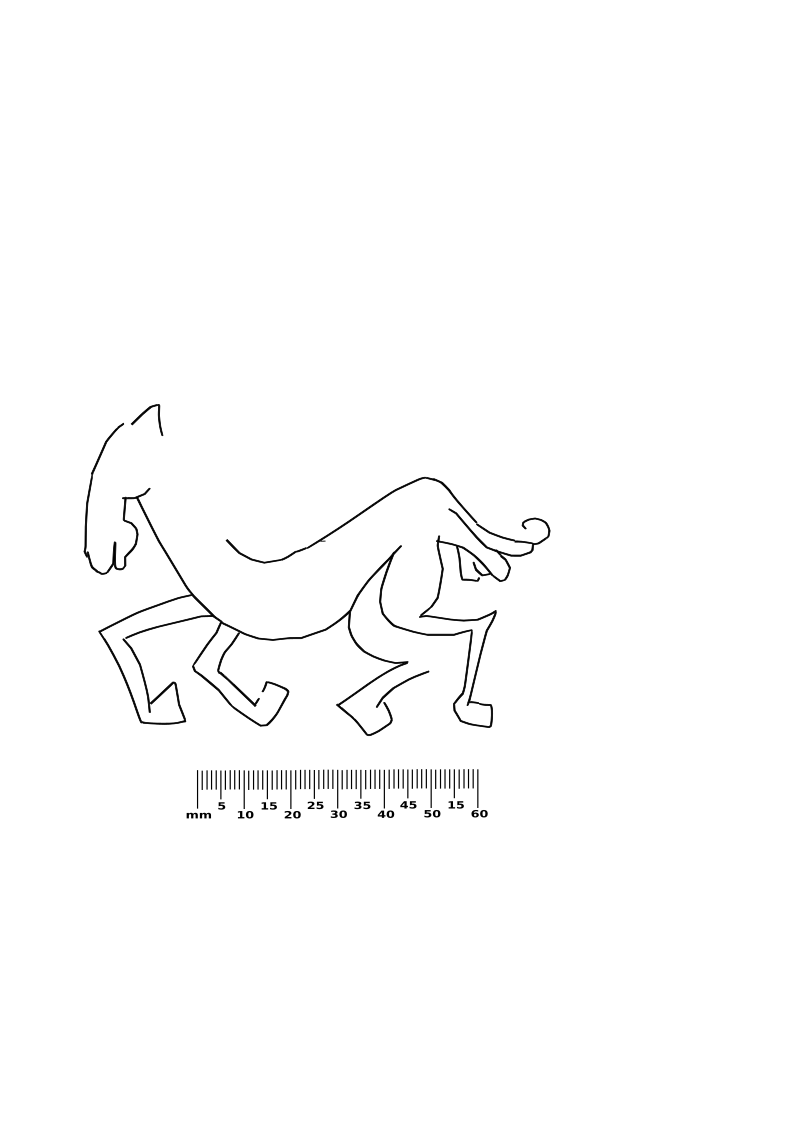
Location: On the north-facing side of the second pillar to the right of door No. 51, in the southern gallery.
Material: Marble surface, 6th century.
Dimensions: Height 7 cm, width 10.5 cm, at 140 cm from the floor level.
Condition: Lightly and fragmentary, but legible incised, intersected by other marks.
Technique: Incised.
Description:
Attribution: A cavalry horse in action.
Publications: none.
Commentary: The graffito depicts a horse in a galloping motion, characterized by its extended front legs and lifted tail, which suggest speed and momentum. The body is outlined with a continuous incision, emphasizing the limbs and clearly defining the neck and head. The composition evokes the iconography of a cavalry horse in action. The animal's form—particularly its robust chest, elongated legs, and raised tail—corresponds to typical representations of steppe-influenced cavalry mounts. Comparable examples appear in John Skylitzes’ Synopsis Historiarum (12th c. AD),[1] where the silhouettes of horses in war scenes closely parallel the forms incised on the marble. The dynamic galloping pose, together with the simplified outline and steppe-influenced proportions, represent a commemorative or votive depiction made by a soldier, artist, or pilgrim connected with the military environment of Constantinople during the Middle Byzantine period.
Date: Middle Byzantine period.
[1] Ioannis Scylitzae, Synopsis Historiarum, 12th century AD, 11r, 14r, 160r, 167r, 186r, 202r, 202v, 224v, 233r, 234r. [viewed 10 October 2025]. Biblioteca Nacional de España (BNE), Madrid. Available at: https://bdh-rd.bne.es/viewer.vm?lang=en&id=0000022766&page=1.