No 32D

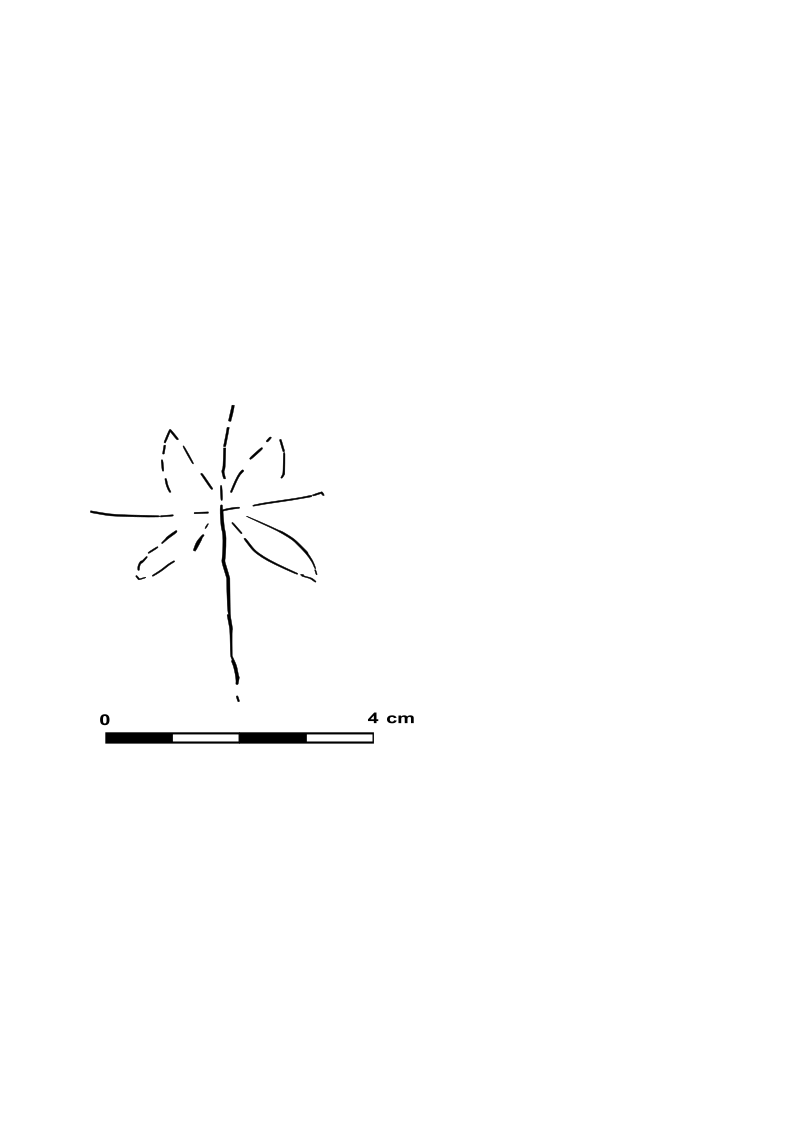
Location: On the balustrade of the fourth box, from right to left, in the central part of the south gallery.
Material: Marble surface, 6th century.
Dimensions: 4 cm (height) x 3.8 cm (width).
Condition: Deeply incised, not intersected by other marks.
Technique: Incised.
Description: A cross with an elongated vertical arm. Superimposed on the cross are additional diagonal strokes forming a floral or petal-like pattern, giving the impression of radiating beams or a butterfly-shaped ornament. The form is reminiscent of decorative crosses found in Byzantine mosaic programs, where the arms are flanked or terminated by floriated motifs.
Аttribution: A flory cross (cross with floral extensions) or crux radiata (cross with rays).
Publications: none.
Commentary: The figure represents a flory cross (cross with floral extensions) or crux radiata (cross with rays). Its symbolic meaning is connected with Christ as “the Light of the World” and with the victory of the Resurrection. The ornamental execution also recalls the visual vocabulary of Byzantine mosaic decoration, especially the borders and medallions in Hagia Sophia. A secondary, more profane interpretation (as a butterfly-like image) is possible but unlikely. Similar decorative crosses appear in the mosaic ornamentation of Hagia Sophia (6th c.) and in Middle Byzantine churches (e.g., Daphni, Hosios Loukas). The adaptation of mosaic motifs into graffiti suggests the intention of the author to replicate the sacred imagery of the church and to inscribe a personal devotional sign.
Date: 11th–14th century AD.