No 1H

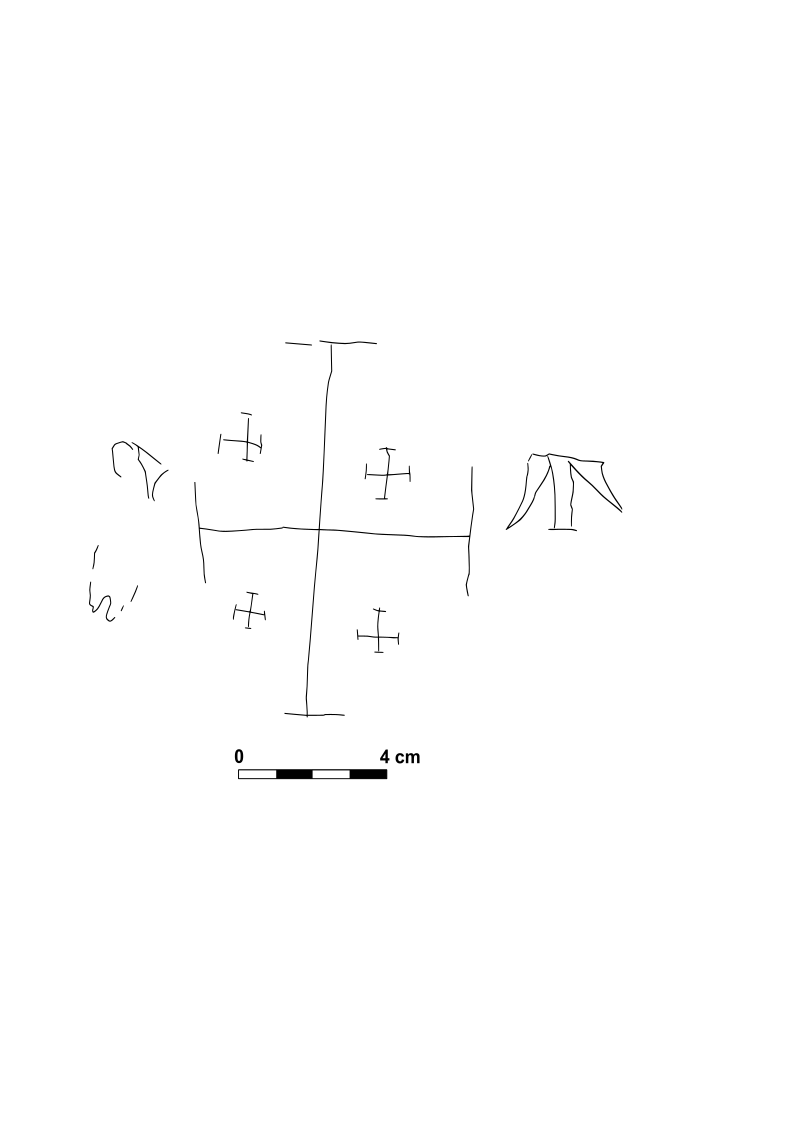
Location: Southern gallery, southeastern pier, north inner wall.
Material: Marble surface, 6th century.
Dimensions: Large cross - width 7.5 cm, height 9.6 cm; Tau cross - left arm 3.5 cm, right arm 3.5 cm, lower arm 2.5 cm, upper arm 2.5 cm; small crosses - 1–1.3 cm; letter T - width 2.9 cm, height 2 cm; situated ~160 cm above floor level.
Condition: Shallow, in places clearly carved, not intersected by others.
Technique: Incised.
Description: Large cross with four small Greek crosses surrounding it; no shield; unclear sign (?) on right; Gothic-style letter “T” on left.
Аttribution (Th. Thomov): Lusignan, King of Cyprus?
Attribution (M. Gorra)[1]: emblem generally applicable to Jerusalem.
Publications: Gorra, Maurizio. Observations and reflections on some coats of arms graffiti in Santa Sofia in Constantinople, Academia.edu
Commentary: The graffito could be associated with the Kingdom of Jerusalem (which adopted it in gold on a silver field), as well as with the Order of the Holy Sepulchre (where it appears in red on a silver field), or with the city of Jerusalem itself in a narrower sense. It cannot be connected to a specific ruling dynasty, since many ruling houses adopted it in their heraldry (e.g., Savoy, Aragon, Habsburg, Bourbon, etc.), including the Angevin rulers, who, however, are more distinctly identified by their own specific coat of arms (lilies with inscription). The absence of a shield supports the possibility that this is a general hieroglyphic symbol related to a knightly order rather than a familial coat of arms.
Date: Mid-14th century AD or later; form attested in Stemmario Gelre (1375) but absent in ca. 1340 (Zürcher Wappenrolle).
[1] I discovered 16 coat-of-arms and decided to share them with my Italian colleague Maurizio Carlo Alberto Gorra who is more competent in the felds of medieval heraldry than I am. He published them on Academia.edu under the title of „Observations and refections on some coats of arms grafti in Santa Sofa in Constantinople“.
In the numbering system (1H, 2H etc.) the letter H after the number signifies a heraldic sign.