No 4M

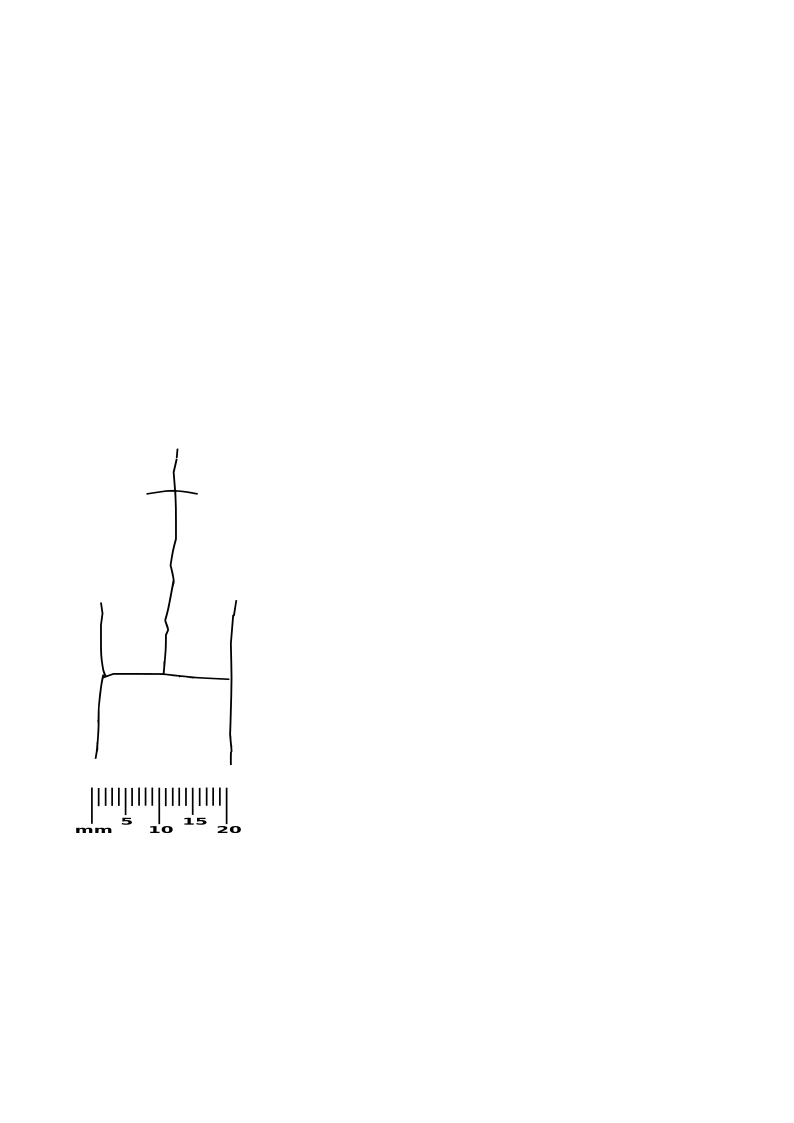
Location: On the short northern wall, next to the last window (from left to right) in the eastern wall of the southern gallery.
Material: Marble surface, 6th century.
Dimensions: 5.6 cm (height) by 2 cm (width), at eye level.
Condition: Lightly incised; not intersected by other marks.
Technique: Incised.
Description: A contour drawing of a Latin letter H, across whose central bar rises a vertical shaft topped by a cross. The composition is deliberately simple, fusing a letter and a cross into a single emblem.
Аttribution: Abbreviated IHS Christogram (cross + H), serving as a protective and devotional mark.
Publications: none.
Commentary: This graffito represents a fragmentary form of the “sacred trigram” or Christogram IHS, a nomen sacrum derived from the first three letters of the Greek name for Jesus (Ἰησοῦς). Used as a symbol of salvation and divine protection, the trigram is attested as early as the 2nd century. In this form, the cross substitutes for the initial 'I', while the 'H' is inscribed in full. It represents the Greek letter eta rather than the Latin 'H'—a distinction often blurred in the Middle Ages, which led to the incorrect Latinized expansion Ihesus. The cross integrated into the letter strengthens the Christological meaning: it is both the salvific instrument and the monogram of Christ’s name. This type of symbol was widely recognized as a protective invocation, marking the presence of faith within the sacred space. From the 14th century onward, the symbol was given renewed prominence by St. Bernardino of Siena, who promoted it as a focus of devotion to the Holy Name. In the 16th century, it was formally adopted as the emblem of the Jesuit order under St. Ignatius of Loyola. With the loss of its original Greek context, the trigram was reinterpreted in the West as a cryptogram for Latin devotional phrases such as Iesus Hominum Salvator—"Jesus, Savior of All".
Date: Late Byzantine period.