No 1D

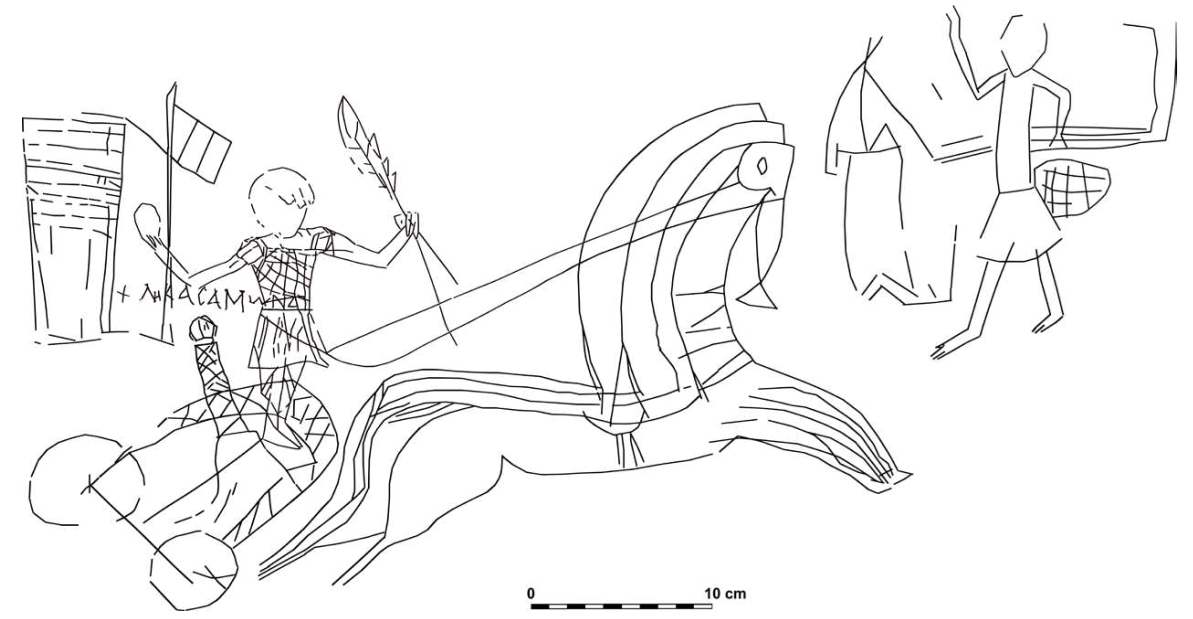
Location: On the marble plate on the left side of the last, southwest, door to the inner narthex.
Material: Marble surface, 6th century.
Dimensions: Height 27.5 cm, length 50 cm, at about 140 cm from the floor level.
Condition: Engraved lightly, with distinct carving in places.
Technique: Incised.
Description: The charioteer stands upright, with both feet within the chariot, and is sustained, while it is in rapid motion, only by the strong hold he has upon the reins. He is depicted bareheaded in three-quarter view, an angle that adds volume to him. He wears a knee-length garb decorated with a hatched pattern. The driver has bands round his thighs, as well as oval protection plates to protect the shoulders. He holds the wreath with his right hand and a palm branch with his left one.
The chariot below the driver is turned to the right and in a three-quarters view toward the viewer. The two-wheeled chariot with four spokes is open behind, being enclosed only in front and at the sides and came hardly higher than the knees. The protective rail is an oval row of X-shaped motifs. The height of the sides decreased progressively to floor level. It is clear that a team of four horses galloping forward pulls the chariot but only the body of the outside one is shown. A line marks the backs and the legs of the others. The charioteer is depicted with the reins wrapped around his waist to allow his hands to remain free. One can also find a hint of the noseband – the band that goes around the horse’s nose. Next, comes the rest of the harness over the animal’s back – a pad or back pad. It is usually used to refer to the smaller lightweight ‘saddle’ of a pair harness. The girth (а strap encircling the animal’s body in order to secure the saddle) can be easily recognized. Another detail is a broad collar over the horse’s breast.
Next comes a strange element consisting of a hatched cone, crowned by a small object resembling an egg, stood on a slightly inclined podium or pedestal. It is just under the right arm of the charioteer. The graffito is highly detailed but when it is looked upon more closely, one can notice a rectangular building with tall pole with flying rectangular banner just behind the driver. At the upper right of the drawing, a second man, salutes him with a raised right arm. A smaller oval seat lies behind the figure.
A Greek inscription below the right arm of the charioteer, in single-stroke (9.7 cm. at length), reads: ‘NH(K)A СAMΏNA’.
Аttribution: Circus scene with a triumphant charioteer.
Publications: Th. Thomov, Samonas the Charioteer: A Graffito Drawing of a Victorious Charioteer at Hagia Sophia, Constantinople (Istanbul), Bulgaria Mediaevalis 10 (2019), 3-33.
Commentary: Thomov, Samonas the Charioteer, 8-22.
Date: between the 6th century (with 537 as a secure terminus post quem) and the 7th century AD.
In the numbering system (1D, 2D etc.) the letter D after the number signifies a drawing.