N 2D

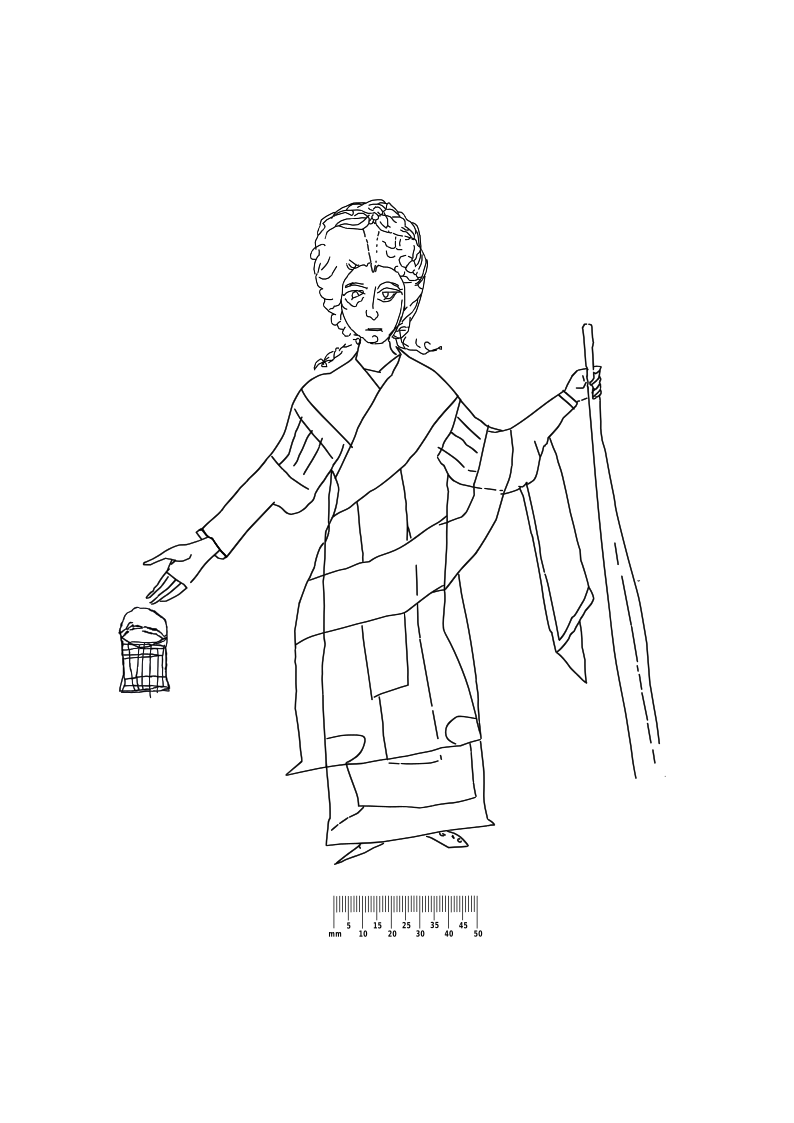
Location: In the eastern part of the south aisle and at the southern side of the soffit of the bema.
Material: Marble surface, 6th century.
Dimensions: Width 18 cm, height 21 cm, at about 160 cm from the floor level.
Condition: Engraved lightly, with distinct carving in places.
Technique: Incised.
Description: It is a carefully painted full-length figure of a youth in a solemn pose. He is clad in a court costume with the traditional crossed loros on top. There is a staff (or a baton) in his left hand, and his right hand points to a vessel with a handle. His thick curly hair is gathered round the head in thick plaits and falls down the back of his neck, his fringe is V-shaped and the ends of a ribbon flutter behind his head. The oval and symmetrical face reveals a strong character. The eyes are large, the nose is sharp and rather straight, the lips are thick and the chin is round.
His long-sleeved undergarment goes down to his feet. The sleeves are quite wide in the upper arm, but are pulled in and caught at the elbow with a narrow cuff at the wrist. The lower hem of the tunic is edged with decoration and from the fact that it is carried upwards at the sides, we can take it that the artist wanted to show that sides of the tunic are open or slit at the bottom in order to facilitate walking. The slit is edged with a stripe ending in a circular segment. His top garment is to his calves, the sleeves are short, loose and to the elbow. They are hemmed with bands. The shoes are decorated with small circles and their toes show. The traditional crossed loros - a very long scarf - is draped diagonally over both shoulders, one end hanging to the lower hem of the outer tunic, and the other end wound around the waist in a complicated way and hanging over the left arm.
Аttribution: Archangel Michael in ceremonial loros costume, guardian of Hagia Sophia, based on the tale from the Diegesis where he remained to guard the construction tools and became the church’s permanent protector..
Publications: E. M. Αντωνιάδου, Ἔκϕρασις τῦς ἀγίας Σοϕѧας, T. II, Αθήναι 1908, 217; Thomov, Th., Chr. Savova, Two Graffiti Drawings in the Church of Hagia Sophia, Constantinople, BULGARIA MEDIAEVALIS 9 (2018), 27-39.
Commentary: Thomov, Th., Chr. Savova, Two Graffiti Drawings in the Church of Hagia Sophia, Constantinople, BULGARIA MEDIAEVALIS 9 (2018), 27-39.
Date: between the second half of the 9th - 10th century AD.