N 3D

Location: On a marble wall plate on the right side of the last door leading to the south-west end of the inner narthex.
Material: Marble surface, 6th century.
Dimensions: Height 21 cm, width 25 cm, at about 80 cm from the floor level.
Condition: Engraved lightly.
Technique: Incised.
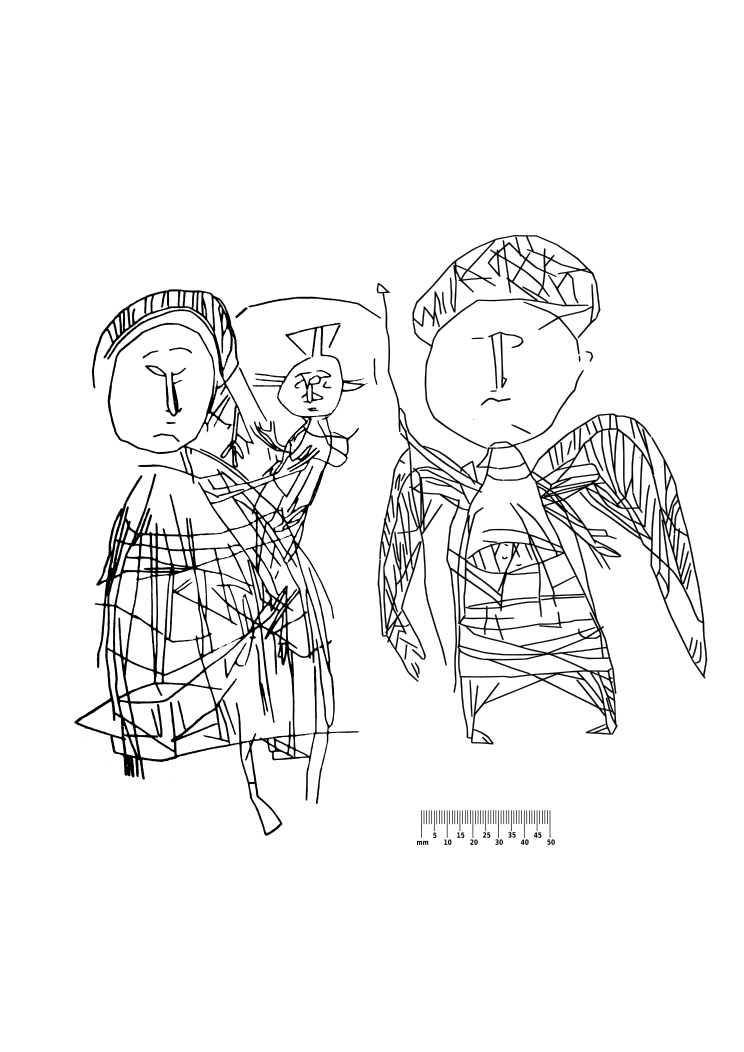
Description: The drawing displays an image of the type of the standing Virgin Hodegetria where Theotokos holds the Christ Child with her left arm and points to him with her right arm. An angel is relegated to the secondary position, standing on the left hand of the Theotokos. He has no imperial attributes, not even the popular halo. The Virgin is depicted in a three-quarter view to the right but her face is turned more towards the spectator. In contrast, the figure of the Archangel is depicted frontally. The nimbus is also omitted from the head of Theotokos. On the other hand, Jesus has a „cruciform nimbus” or a cross inside of the halo over his head. The cruciform nimbus is only used for Christ and rarely for someone else in the Trinity. The figures are shown with schematic faces without any distortion. However, the hands are drawn in a very simple, childish way. In the images of Theotokos and her Child, one can find more details – palms with four fingers, legs in the right position (the left leg of the Child is simply marked) or some footwear (of Theotokos). The image of the Archangel is represented by elementary primitivism and only his wings are very detailed. It is difficult to distinguish the clothes of the Child and the Archangel. Theotokos wears a short hatched tunic with a V-shaped collar. In all probability, the use of the hatch was a technique to show the traditional blue colour of the dress. As a headdress she wears a kerchief concealing her hair and revealing only the lobe, and a decorated with bands maphorion. The latter, edged with a triple pendant, descends on the left side of the head and slants behind the figure of the Child reaching the waist of Theotokos. She looks at the viewer and points with her right hand to the Christ child. The Child Jesus sits upright supported by Mary’s left arm. His right hand is raised in blessing and he holds a scroll in his left one. These distinguishing characteristics signify that the Child is both the pre-existent Logos (the scroll) and the coming Saviour (the blessing sign). The author has attempted to follow the peculiar iconography of the Child and to depict his raised right hand as a sign of blessing. However, he misinterpreted the gesture and drew the right hand with an open palm. Moreover, the graffito gives us the impression that the scroll is depicted in the hand of the Virgin Mary just because Jesus’s left hand is not seen. The Archangel, he is holding a spear in his right hand, while the open palm of his left hand is turned upside-down. His thick and hatched hair is falling down the back and has the shape of a present day beret. In spite of all mistakes, the author’s intention was to depict the Mother of God in a standing pose known as Hodegetria, gesturing with her right hand toward her Child, who sits upright on her left arm holding a scroll.
Аttribution: A standing Hodegetria, gesturing with her right hand toward the Child, who sits upright on her left arm holding a scroll. This type of Hodegetria is probably flanked by two angels.
Publications: Thomov, Th., Chr. Savova, Two Graffiti Drawings in the Church of Hagia Sophia, Constantinople, BULGARIA MEDIAEVALIS 9 (2018), 40-52.
Commentary: Thomov, Th., Chr. Savova, Two Graffiti Drawings in the Church of Hagia Sophia, Constantinople, BULGARIA MEDIAEVALIS 9 (2018), 40-52.
Date: 9th or 10th century AD.