No 6D

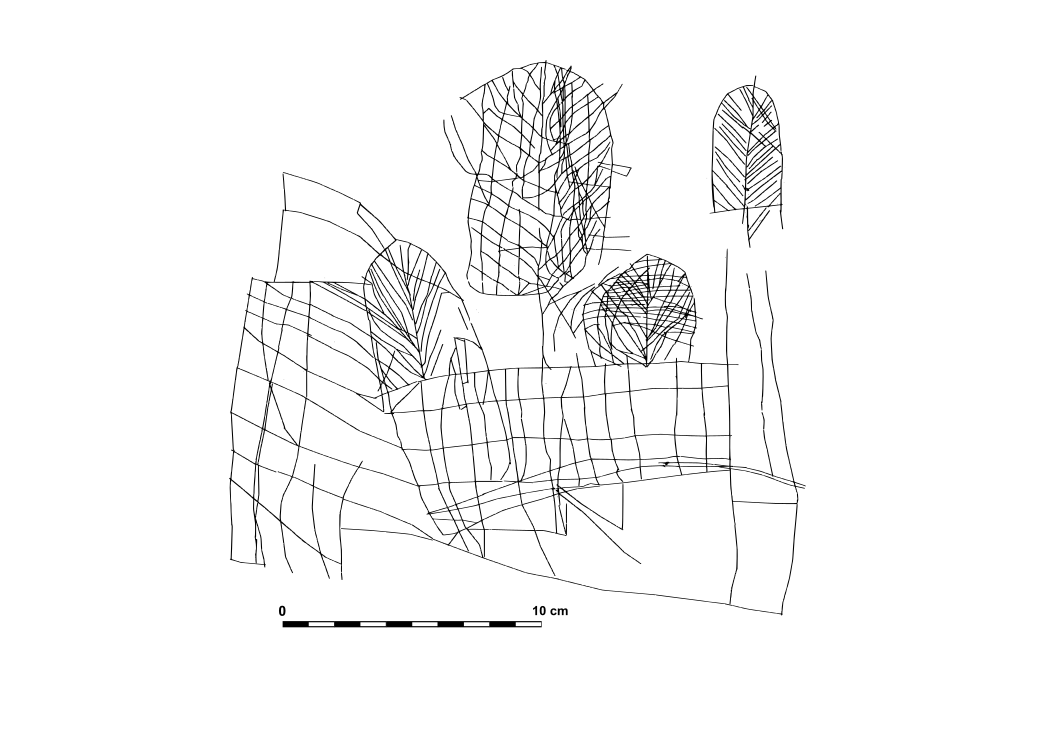
Location: On the south wall of the southeast pylon in the south aisle.
Material: Marble surface, 6th century.
Dimensions: 21.5 cm (height) x 22 cm (width), at eye level.
Condition: Lightly incised, not intersected by other marks.
Technique: Incised.
Description: The graffiti depicts a composition with a geometric base resembling a structure or enclosure, upon which several trees with oval crowns are drawn. The crowns are filled with dense cross-hatched or feather-like lines, emphasizing foliage. On the left and right sides, vertical elements appear, which may be interpreted as architectural features or stylized columns. Overall, the scene suggests an enclosed space with trees.
Аttribution: The Paradise garden (hortus conclusus).
Publications: none.
Commentary: The scene can be interpreted as a representation of a garden or courtyard with trees, enclosed by a wall. In Christian symbolism, such imagery often evokes the Paradise garden (hortus conclusus), the eternal dwelling place of the righteous and a symbol of salvation. Byzantine and post-Byzantine art frequently depicted Paradise as a walled garden containing trees, fountains, or architectural structures. The schematic rendering of the foliage with cross-hatched lines recalls the stylized patterns found in manuscripts and mosaics, where vegetation was often conveyed in a repetitive, decorative manner.
Date: Most likely Late Byzantine or early Ottoman period.