No 7D

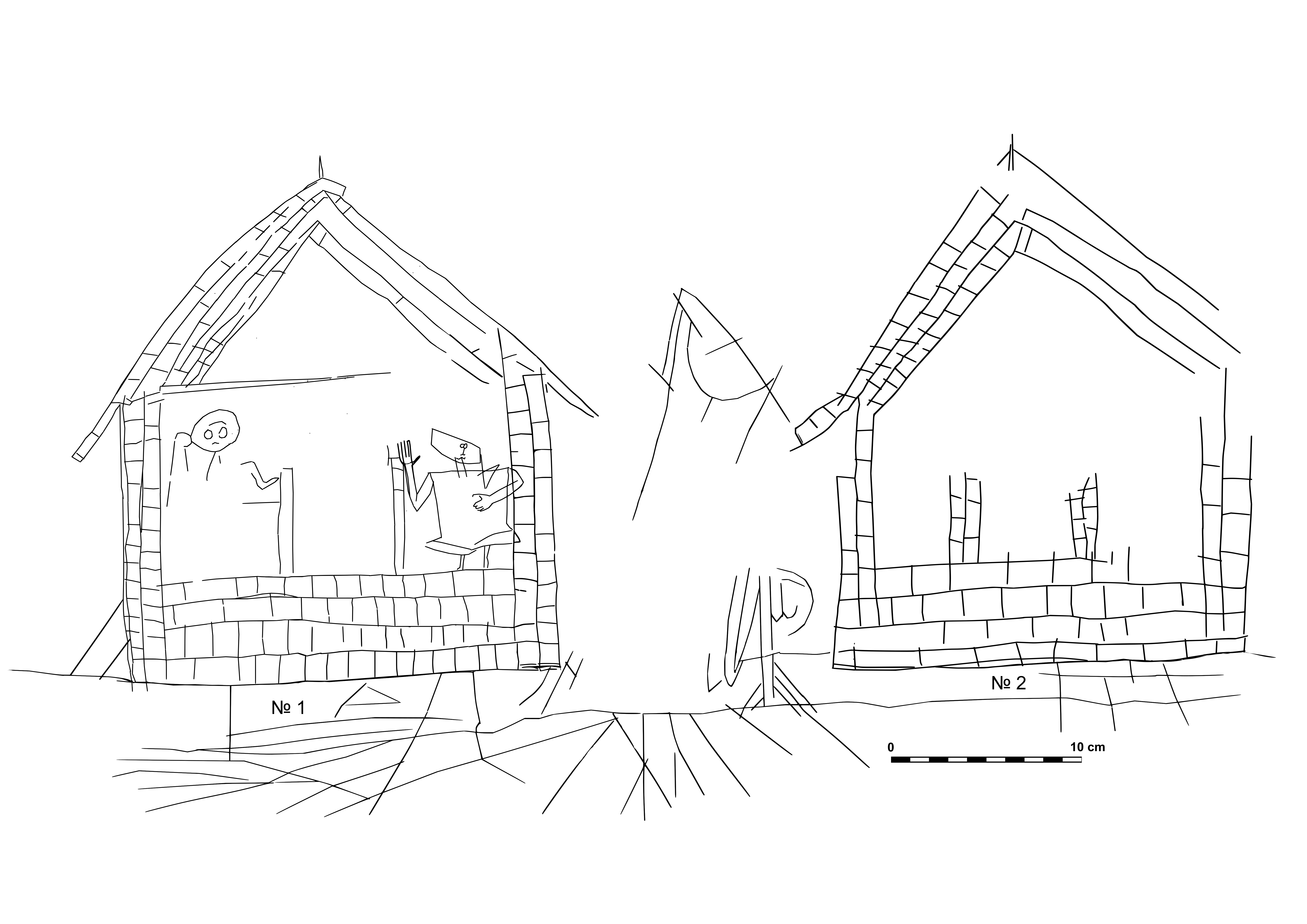
Location: On the south wall of the southeast pylon in the south aisle.
Material: Marble surface, 6th century.
Dimensions: No 1: 27 x 28 cm; No 2: 27 x 24 cm, at 95 cm above the floor.
Condition: Lightly incised, not intersected by other marks.
Technique: Incised.
Description: The graffito depicts a building (No 1) with a pitched roof and clearly marked stone masonry, presented frontally. The structure is divided into two rooms by a vertical partition wall. In the left compartment stands a female figure with a trapezoidal head and a pendant falling to one side; her garment ends with a double hem. She raises her hand in a gesture of greeting or farewell. In the right compartment, a smaller figure with a round head and circular eyes lies in a bed or cradle with a high back, suggesting the image of a child. Building No 2 is a parallel or adjacent house, similar in architecture, with pronounced masonry and roof, but its interior is empty, marked only by three vertical elements, reminiscent of columns or walls. A tree is implied between the two houses. The scene depicting the two buildings suggests the idea of a populated environment.
Аttribution: A house with a woman and child, serving as a visual prayer for divine protection.
Publications: none.
Commentary: Although domestic in subject matter, the graffito’s location on the wall of a church indicates a devotional function. The scene represents not simply a woman and child at home, but a visualized prayer by the absent author, seeking divine protection and blessing for his family. Instead of a written formula, the supplicant has used an image as a personal invocation, transforming the everyday into sacred intercession. The depiction of the building’s façade with carefully drawn rows of stone blocks reflects a schematic style familiar from Middle Byzantine manuscript miniatures and wall drawings, where houses and churches are often presented in simplified frontal views.
Date: Middle Byzantine period.